Friday, May 21, 2010

Blade Runner: Love and Death of the Simulacra


Bereft of a concept of the 'real', Marx's economic base and dependent superstructure simply collapsed into each other. All that remained were empty signifiers of value and meaning which no longer belonged to any larger social or economic system. This created, in a terminology that became extremely fashionable during this period, the reign of the 'simulacra.'

-- Eleanor Heartney, Postmodernism

The simulacra are presences or appearances that have lost their ground in being or reality. They appear to us as real, but are only illusions that cause us to forget about reality, or toforget to ask the question, "what is real?" A simulacrum is like a reflection in a glass window: it has all the appearance of reality, but none of the substance. Heartney is refering to the popularity of this term in 1980s art criticism. Although its entrance into art critical discourse appears to correspond with technological changes, such as genetic research, that suggested the possibility of producing sythetic life, questions surrounding hyperrealistic representation have been a feature of art theory for a very long time (e.g Pygmalion).

Ridley Scott's movie Blade Runner is a captivating exploration of issues surrounding the presence of simulacra in human society. The world of Blade Runner is a post-consumer apocalypse in which human industrial and technological expansion has ravaged the earth. The market for genetically modified and produced objects, food, etc. is huge, and scientists even discovered a way to create 'people', called replicants, who act almost exactly like human beings. But they are different in significant ways. In producing the replicants, these future dwellers of earth committed one of the top ten big Sci-Fi mistakes: never create humanoid creatures that are exactly like you in all respects, except for their superior strength, agility and intelligence. Fortunately, the (real) humans were not completely inept. They did program the replicants to to have a life span of 4 years and to be emotionally impaired.

Rick Deckard (Harrison Ford) is a 'blade runner'. He catches and kills replicants living on earth. All replicants are forced to live off of planet earth (in fear of a hostile take over), and so the blade runners were organized as enforcers. Even at the beginning of the movie it is clear that Deckard does not like his job. He is a reluctant blade runner. As the film progresses, it becomes clear why hunting and killing physically superior beings is not for everyone. But perhaps more disturbing than the fear of fighting a replicant is the injustice implied by the killing of creatures that are so similar to humans, and that only exist because humans made them.

One of the most remarkable scenes in the movie is a chase with Deckard and Zhora (Joanna Cassidy). Zhora is a replicant that Deckard finds performing in a bar, and she proves to be a very difficult catch. Realizing that Deckard is a blade runner, Zhora gets a head start and the chase ensues. Eventually, as they approach something like a mall or shopping center, Deckard catches up. Zhora smashes through the closed glass door or window and runs down an aisle flanked by more glass, and mannequins posing and watching from behind the glass. As she runs down the aisle, Deckard shoots and fresh red blood erupts from her chest and spatters on the inside of Zhora's clear plastic jacket. Zhora continues to run, though she begins to slow down, and eventually dives through another window as she is shot again, and she falls to the ground dead.

The scene in the mall is utterly dazzling and disorienting. The large amount of glass and reflected light confuses the eye, and one wonders where reality and reflection begin and end. As she dashes through this hall of mirrors, Zhora is surrounded by mannequins who, like her, are only imitations of the real. They gaze upon her in solemn, undisturbed reflection as she lunges to her death.

Confronted with the simulacrum of death, it seems as though Zhora has transcended her own status as imitation and approached, perhaps become, the real. Certainly Deckard, and myself as the viewer, feels uneasy about all this because it raises questions about how one defines humanity. We feel that out actions in the face of death is some part of what makes us human, and yet to see Zhora die, and to feel the loss of her death, requires us to reconsider what it means to live and die as a human, and not merely as a simulacrum.

Throughout the movie, Deckard develops a friendship, and then more intimate relationship, with Rachael (Sean Young), who is also a replicant. By the end of the movie it is clear that they love each other, and it is only suggested that Deckard helps her to escape those who would hunter her down. But, again, we are left to question what is it that makes us human? If love is not a quintessentially human action then what is? Does Rachael love Deckard, or is she only capable of the imitation of love? When the simulacra love and die, we are shaken to our core. If we cannot distinguish our love or death from theirs, then who is to say that one is real and the other imitation.

Thursday, May 20, 2010

The Parisian Job


500 Million Euros! Somebody has good taste. My office mate, and personal assistant (he he he), David Sonju directed me to this article earlier today. Apparently, a very clever theif (or group of theives) was (were) able to rob the Musée d'Art Moderne de la Ville de Paris of five very expensive paintings. The hit list includes Picasso, Matisse (his painting La Pastorale, above, was stolen), Leger, Braque, and Modigliani. It is a literal "who's who" of French modern painting. As far as I know, no one has been arrested in connection with the burglary. If the art theives happen to be reading this, and are feeling generous, a donation of a small piece of the Matisse of Picasso would go a long way towards erasing my school debt after this PhD. If you aren't interested, then please take them back.

Wednesday, May 19, 2010

When Protagonism becomes Antagonism [Part I]: The Boy in the Striped Pajamas


The literary terms 'protagonist' and 'antagonist' are common enough. The 'protagonist' is the main character of a play, film, or story. The 'antagonist is the one who opposes the protagonist: he, she or it is a source of frustration, conflict, and tension. Less common, is the related word 'protagonism.' A concise definition of protagonism could be: 'an active support of an idea or cause; especially the act of pleading or arguing for something.' I do not know the etymological and historical relationship between 'protagonism' and 'protagonist,' but placing them side by side is suggestive. The protagonist is the one in the story toward whom the reader lends support and encouragement. We want Frodo to throw the ring into mount doom, and an adept author like Tolkein is able to direct and develop our sympathies for Frodo and his fellowship. But what happens when our protagonism turn us into antagonists?

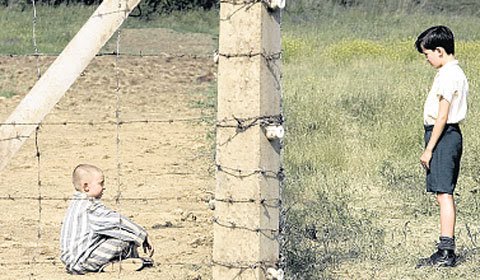
The Boy in the Striped Pajamas is one of those movies, like Schindler’s List, that makes evil disturbingly palpable. The protagonist is a young boy, Bruno, whose father administers a Nazi WWII concentration camp. Their family moves to a house not far from the camp. Naturally, the boy is curious about the camp and the people there. And his parents’attempts to keep him confined to their house (or, better, prison) only manages to fuel his fascination with what is going on in the ‘outside world.’

Bruno is a source of freedom, innocence and hope in the midst of a very dark story set in one of the more disturbing episodes of world history. Throughout the film, his vibrant and carefree spirit drew me in as I gradually, seemingly naturally, became his advocate. When his parents, and especially the hired tutor, discourage Bruno’s inquisitiveness, restrict his imaginative play, and refuse to let him play in the forested area around their home, I am forced to choose sides.How can I not cheer for the winsome Bruno who is forced to grow up too quickly, but at the same time is sheltered from the horrific realities of living in a time of war.

When Bruno found a way to escape from the house, I could not help but feel a thrill of excitement and hope. Now, the stifling fear can really be left behind. And when he finds the concentration camp, and meets Schmuel, a young Jewish boy his age (the only boy his age that he can call a friend), how could I not want him to bring food to the famished Schmuel. How could I not want Bruno to play with Schmuel through that terrible barbed-wire fence. What was I thinking?Perhaps I thought that this relationship could bring some kind of redemption to the horror and tragedy of genocide. Perhaps I wanted to the boys to at least have friendship for they both, in their different ways, had very little of life and happiness. Whatever the reason, and it sure felt like a good reason, I wanted their friendship to grow.

On the day that Bruno came with a shovel and a sandwich, and he offered to help Schmuel to find his father (who he had not seen for days), I wondered if something unspeakable were about to happen. And yet, I cheered when Bruno put on the striped uniform, and I cheered when he slipped under the fence. I could not help it because, I thought, here is an image of reconciliationand here is hope that injustice will not continue forever. I could not help it, but the moment he was on the other side, I regretted it. The boys ran through the camp, and searched in several huts, but, before long, they were caught up and corralled by German soldiers in a forced march.The marched in the middle of the group unable to get out and unable to see where they were going. They marched into a room where they were forced to take their clothes off. They marched into a room where they were pushed even closer together. Then, the soldiers shut the large metal door. I regretted that I ever wanted Bruno to be friends with Schmuel, let alone crawl under the fence, but I had wanted that. I had cheered him to his death.


Tuesday, May 18, 2010

Bird Stealing Bread


Most of my blog posts, lately, have been about visual images. They are an attempt to bring words to a visual metaphor, and to explore its possibilities. But words themselves can generate imagery, and not merely describe it.

Today I was listening to Bird Stealing Bread by Iron and Wine, and I was stuck by the potency of some of the metaphors and the suggestiveness of the imagery. In particular, the way that Sam Beam plays with different aspects of the bird image is quite wonderful. Just to warn you, it is a sad song, and it is definitely worth the time. So I thought I would post the lyrics and encourage to you go to the Iron and Wine website and have a listen:
Tell me, baby, tell me
Are you still on the stoop
Watching the windows close?
I've not seen you lately
On the street by the beach
Or places we used to go

I've a picture of you
On our favorite day
By the seaside
There's a bird stealing bread
That I brought
Out from under my nose

Tell me, baby, tell me
Does his company make
Light of a rainy day?
How I've missed you lately
And the way we would speak
And all that we wouldn't say

Do his hands in your hair
Feel a lot like a thing
You believe in
Or a bit like a bird
Stealing bread
Out from under your nose?

Tell me, baby, tell me
Do you carry the words
Around like a key or change?
I've been thinking lately
Of a night on the stoop
And all that we wouldn't say

If I see you again
On the street by the beach
In the evening
Will you fly like a bird
Stealing bread
Out from under my nose?

Monday, May 17, 2010

Looking, Eavesdropping, Watching


I have been thinking a lot about how when we look at a painting we not only complete or finish what the artist began, but we also can become unwitting participants in the fictional world of the painting. In his wonderful essay "The Work of Art and Its Beholder," Wolfgang Kemp argues: "In the same way that the beholder approaches the work of art, the work of art approaches him, responding to and recognizing the activity of his perception." Kemp's essay is essentially an explanation of "aesthetic reception,"a methodological approach to art history, which takes this aspect of works of art very seriuosly. Aesthetic reception recognizes that works of art are made for an "implicit beholder" and that looking at works of art involves an "asymmetrical" communication between the artist and the real beholder.

He develops his theory through a wonderful and interesting analysis of Nicolas Maes' The Eavesdropper (above). In many ways, this painting is an ideal example for aesthetic reception. Of course there is an implicit beholder because the painting addresses the viewer through the maid who looks "out" of the painting and the curtain that partially obstructs the viewer's line of sight. The painting is a comment on the moral implications of looking, and it invites consideration of when an onlooker becomes a voyeur or eavesdropper.

In a sense, the painting provides the viewer with a fictional choice. Should we join the maid in her invitation to be an eavesdropper? Should we pull back the curtain? Kemp's comments in this regard are interesting. He writes:
The curtain has been drawn back to such an extent that half of the eavesdropped conversation becomes visible: A woman who stands behind a table and who, judging from the position of her arms, which she has on her hips, and her head, which she holds at an angle, reproaches a person opposite her. If now, as a result of the eavesdropper's invitation, we become active ourselves in the right half of the painting and lifted the curtain or tried to look behind it in our thoughts, the blank would close and we would really become the eavesdropper's accomplices. That this is not possible ... that by the art's grace we have "only" the painting, is made obvious by the curtain, which, as an everyday instrument of veiling and unveiling, yet belongs wholly and doubly to art by being part of the matter of the painting and, also as the painted curtain, its sign.
After reading Kemp's discussion of The Eavesdropper, I was reminded of the work of contemporary painter Eric Fiscl. Many of his paintings, like Maes', have a domestic setting. In particular, Fiscl's paintings of domestic interiors tend to look like fairly innocuous middle to upper-middle class homes. They would be a fine illustration of "suburban America." But in these familiar settings (at least for those who live in homes like them) we are confronted with scenes that are often disturbing in their display of sexuality. For example, his paintings Bad Boy (1981) and Birthday Boy (1983) are highly suggestive of an incestuous relationship between a young boy and his mother, or at least of a sexual relationship between an older woman and young boy. What is interesting about many of Fiscl's work, is his ability to make the viewer feel as though he is witnessing and potentially implicated in the scene before him.


His painting The Bed, The Chair, Dancing, Watching (2000, above), masterfully draws the viewer into the action of the scene. A middle aged man sits, nude, upon a white chair covered in a strikingly red floral patter. He looks straight at me, scrutinizes me. I become aware of a shadow on the wall, and I recognize that woman is undressing before this man, and that I am somehow standing in her place. What relationship do these two people have? What exactly is going on here? Needless to say, I feel uncomfortable and unnerved looking at this painting. Unlike Maes' painting, Fiscl does not provide me with a curtain. I do not have a choice. By looking at the painting I am thrown into the scene and become a participant, become complicit, as this narrative unfolds. The bed directly behind the man suggests where the story is headed, and his gaze is hardly one of love and care.


Saturday, May 15, 2010

Vote for Old Radicals

The team at Noonday Films have put together a fantastic documentary called Old Radicals, and you can watch and vote for it here at the International Documentary Challenge. It is a captivating story about courageous love and the unflinching pursuit of justice. The documentary is a moving story about a couple who risk their lives protesting corrupt regimes. And, no, they aren't idealistic college students trying to save the world. They are at least old enough to be my grandparents, and they are trying to save the world. Old Radicals questions commonly held assumptions about what counts as a "good" life, and it encourages us to make a difference.

Friday, May 14, 2010

Andy Goldsworthy [Part II]: Risk and Control

Goldsworthy intentionally incorporates a tension between risk and control within his creative practice. One way that this tension manifests itself in his work is through the relationship between geometric and natural form. Many of his sculptures take on the character of pure geometric shapes and volumes (such as circles, spirals, cubes, cones, etc). Geometry provides Goldsworthy with an ideal that he can never reach. His attempt to achieve perfection within a recalcitrant material gives his work a certain vibrancy and life. Striving for perfection provides Goldsworthy with an element of risk that actually enhances the quality of his work.

An excellent example of how Goldsworthy incorporates this tension between geometry and nature into his work is his Three Cairns project. “The project consists of three temporary cairns, three permanent sculptures, and three museum exhibitions.” Produced on a massive scale, the space between them stretches across the North American continent. The permanent cairns remain at museums in San Diego, California (the west coast), Purchase, New York (the east coast), and Des Moines, Iowa (central). The enormity of the Three Cairns project is suggestive of this Scotsman’s attempt to grasp the vastness of the North American continent.

The construction of a cairn typically requires some mathematical precision because it must be able to support its own weight. Nevertheless, Goldsworthy rarely uses mechanical devices or engineering manuals. Reflecting on this theme in his work, Goldsworthy writes,

The cairns are made by eye. I use a tape measure, just to keep within the limitations of the width that I feel is stable in proportion to the base. I always attempt to make the perfect cone but fail. A tension between what I want and what is emerging. This tension is important to the feeling of the piece.

The tension between geometry and the natural form is further heightened in Three Cairns because mathematical precision is the only way to connect the physically distant cairns to one another. Goldsworthy writes, “It is the way I carry with me the East and West Coast cairns and can project them into the space at Des Moines.” The difference between the ‘perfect cone’ and the one that is actually constructed could be seen as a flaw in his work, but he suggests that it is a fundamental aspect of the cairns.


Goldsworthy himself speaks about the process of building a cairn in which he, as one dialogue partner, is not in complete control. He writes the following at the time of constructing the “West Coast Cain” at the San Diego Museum of Contemporary Art:

I am now locked into an intense dialogue with the stone. There is a feeling of physical engagement with the material that is consuming and at times exhausting, a struggle in which a moment’s lapse of concentration can lead to a loss of control.

What is so interesting about Three Cairns is that the value of this “loss of control” is called into question. He writes, “Normally [a loss of control] can be interesting, but the parameters I have set for myself in the Three Cairns are so tight that they do not allow for that kind of variation.” His journals at the time that he was in North America constructing Three Cairns reveal an internal debate over how much this particular project can be made in his typical dialogical manner. While working on the “East Coast Cairn” for the Neuberger Museum of Art in New York Goldsworthy speaks much more positively about a lack of control in his creative practice:

Sometimes I feel that the source of a sculpture’s energy comes from the effort of trying to regain a sense of balance lost at some point when I lacked control or concentration or perhaps made an error of judgment.

As valuable as the experience of overcoming a loss of control can be, it is nevertheless very frustrating for the artist. While working on the “Midwest Cairn” in Des Moines, Iowa, Goldsworthy writes:

I had to leave the site and find a quiet indoor space in which to work out dimensions away from the stone. This is a very different way of working for me: problems are usually best solved in the making. This sculpture however needs a different approach. I need to look at the space between the three cairns as well as the stone in front of me.

Leaving the site on which he is working may not seem that radical, but considering the importance of place and the physicality of his materials, this choice by Goldsworthy reveals that he is willing to depart from his normal mode of practice to successfully complete these sculptures. Thus, the tension introduced by greater mathematical precision in Three Cairns proved to be a struggle for Goldsworthy, and one that provoked an exploration of new ways of making.

Thursday, May 13, 2010

The [Outrageous] Lives of the Artists


A common feature of 'modern artist' biographies is the inclusion of stories that illustrate the artist's propensity for eccentric, bohemian, or deviant behavior. While clearly contributing to the mythology of the 'modern artist', these stories can be rather fun (and also a little disturbing). I was reading Gils van Hensbergen's Guernica: The Biography of a Twentieth-Century Icon when I ran across this little nugget:

Not long before the delivery of [Guernica to the exhibition site] Marie-Therese walked into the studio to find Picasso up on his ladder and Dora at his feet. For Picasso, it remained 'one of his choicest memories'. Francoise Gilot, Picasso's partner after the war, remembered the story as told to her by him:
"I have a child by this man. It's my place to be here with him," said Marie-Therese. "You can leave right now." Dora said, "I have as much reason as you have to be here. I haven't borne him a child but I don't see what difference that makes."
Picasso refused to intervene, preferring to watch the two women fight it out.
Finally, Marie-Therese turned to me and said, "Make up your mind. Which one of us goes?" It was a hard decision to make. I liked them both, for different reasons: Marie-Therese because she was sweet and gentle and did whatever I wanted her to do, and Dora because she was intelligent... I told them they'd have to fight it out themselves. So they began to wrestle.
Picasso's relationships with women were, to say the least, complicated. During the making of Guernica Picasso would stay with his wife(?) Marie-Therese and their daughter on the weekends, but during the week he was working in Paris and accompanied by his mistress Dora Maar. This tale is the kind of soap-opera-situation that no one imagines would happen in 'real life', but when it happens to an artist we nod our heads and chuckle softly to ourselves.

Stories such as this one mythologize our notions of artistic practice by suggesting that creative power at least partially derives from the artist's capacity to break the rules. It is often assumed that living in a different, unique, or unusual is directly related to (or at least naturally associated with) the ability to produce works of art that exhibit a high degree of originality. But is this the way that creativity works? Is creative practice really antithetical to commitment and responsibility?

Monday, May 10, 2010

Andy Goldsworthy [Interlude]: In the City

Photo courtesy of Boutwell Draper Gallery

Another post of considerable length with further reflections on Goldsworthy's creative practice will arrive shortly. But, until it does, I thought I would share an excerpt from a recent article on Goldsworthy's work that Jon Mackenzie brought to my attention. The artilce, by Mike Wade, appeared in The Times Saturday May 1 2010:
You are not going to credit this, he says, his keen eyes shining with laughter, but he was almost arrested by the NYPD a month ago -- simply for being an artist. He'd been trying to make rain shadows outside the Rockefeller Center. His plan was to lie down on the pavement, just as a shower began, so that the dry shape of his body would remain after the raindrops soaked the concrete around him. Alas, as soon as he set about his work the long arm of the law intervened. "There is a video of me being evicted from outsid Fox News," Goldsworthy snorts. "Corporate America has such a fear of a terrorist attack. They own the bloody sidewalk."

So he was frogmarched away? "Oh yeah. To be honest, the police were great about it. They wanted to know what I was doing but the were OK. The security guards simply would not look me in the eye. I said to one guy, 'What's wrong with the world? I had far more freedom in Moscow when it was under communism than I have had in New York this week.' It was really oppressive."

Saturday, May 8, 2010

Andy Goldsworthy [Part I]: The Land

"The assumptio carnis means that God willed to coexist with the creature, that the creator willed to exist also as a creature for the reconciliation of the estranged world to himself." -- T. F. Torrance [1]

At the heart of Andy Goldsworthy's work is his personal relationship to the land. He works with objects in and elements of the land: using sticks, rocks, mud, clay, leaves, etc. He works in various environments and locations: fields, forests, rivers, mountains, city and gallery. Goldsworthy also travels away from his home in Scotland to other locations, such as Japan, the North Pole, or Spain. He works in the landscape: he explores landscape as a place that envelops and enfolds the human person. He works in a place: he is aware and makes use of the various processes -- natural and social -- that shape the land, and that precede and outlive his presence there. Goldsworthy explores all of these different aspects of what one can mean by 'land' through a creative practice that is both personal and intimate.

Goldsworthy's materials are the landscape. In relationship to the land, his creative practice has an epistemic goal; he hopes to discover something about his materials. In an interview, Goldsworthy emphasizes the exploratory nature of his creative practice:

I have an art that teaches mea very important things about nature, my nature, the land and my relationship to it. I don't mean that I learn in an academic sense; like getting a book and learning the names of plants, but something through which I try to understand the processes of growth and decay, of life in nature. Although it is often a practical and physical art, it is also an intensely spiritual affair that I have with nature: a relationship.[2]
Goldsworthy's creative practice is an act of discovery, but this is qualified by the statement that he is not trying to "learn in an academic sense." Instead, Goldsworthy's exploration of the landscape takes place within the intimacy of a committed relationship. He chooses to fully immerse himself in the physical terrain, and thereby gather a kind of "working" knowledge of the world as a whole. This epistemic dimension resides at the core of his work: "At the heart of whatever I do are a growing understanding and a sharpening perception of the land."[3]

Goldsworthy is profoundly aware that his presence as an artist is manifested in a place, and not simply before a homogenous mass of material. He writes, "When you make something [in Britain], unlike America, you work with a place that is so full of the relationship between people and the land, and also made so rich by it... The social nature of the British landscape demands to be acknowledged."[4] Goldsworthy's awareness of the land's human history, as well as its natural history, is evident in the long-term project Sheepfolds that seeks to restore numerous sheepfolds in Cumbria. His presence in Cumbria is like one stepping into a story already being told: he largely works on existing sites and he aims at restoring a function that has been part of the Cumbrian economy for hundreds of years. Although Sheepfolds is a highly original artistic project, it nevertheless is in continuity with the history and traditions of a place.

Goldsworthy's creative practice creates a space in which the land reveals its own creativity and beauty. His work is an act of discovery that finds in the ordinary stuff of the world an extraordinary element. The room required to achieve this discovery, to allow the land to present its beauty and meaning, is made by entering into the land and identifying with it as closely as possible. Similarly, in the incarnation, God comes to His creation in full creatureliness and reveals the true meaning of what it is to be a son or daughter of God. We may find a parallel here with Jeremy Begbie's suggestion that human creator's are to be "secretaries of God's praise."[5] Begbie argues for a Christologically oriented creativity which understands that "biblical language about the relation between Christ and creation should properly remind us that God's love for creation entails him honoring its integrity distinct from himself."[6] For Begbie, human creativity is understood as participating in the movements of the trinity. He writes,
In the humanity assumed by his Son, the Father has released our humanity from its crippling self-concern in such a way that a new corporate humanity has been made possible, one which is bound together with that same self-forgetful love which binds Father and Son. [7]
Goldsworthy's creative practice avoids modern obsessions with self-expression and individuality, and explores what it means to be in relationship with the land. At the same time, however, he 'uses' the land as his material. The epistemic nature of his creative practice is always seeking out new aspects and potentials of the land. Goldsworthy makes discoveries and brings them before the viewer in such a way that the land is felt to "speak for itself."

[1] T. F. Torrance, Incarnation, (Milton Keynes: Paternoster, 2008), 65.
[2] Andy Goldsworthy, Hand to Earth (London: Thames and Hudson, 1990), 164.
[3] Andy Goldsworthy, Collaboration with Nature, (New York: Abrams, 1990), 4.
[4] Andy Goldsworthy, Andy Goldsworthy: Sheepfolds (Michale Hue Williams Fine Art, 1996), 17.
[5] Jeremy Begbie, Voicing Creation's Praise (London: T & T Clark, 1991), 177.
[6] Ibid, 171.
[7] Ibid, 180.

Monday, May 11, 2009

Beautiful Reasons

The expert film-making duo of Matt and Elisa have done it again!  They have presented us with a very personal and intimate story of Matt's own struggles with anxiety and the places that he finds hope and love to overcome them.  In this short documentary, Matt opens up a quiet space within his own life that is filled with fear and despair, and yet even more full of hope.

Matt and Elisa entered this documentary into a contest, and they were selected as one of thirteen finalists.  On the website where you can view their film (it is only five minutes, you have time), and vote for the audience choice award.  There are so many reasons to vote for 'Beautiful Reasons.'

See the documentary here. 

Wednesday, April 29, 2009

The Worldview Behind the Work of Art: Five Cautionary Statements

Analysing a work of art by constructing a worldview that supposedly shaped the work of art is currently a fashionable trend in Christian engagement with the arts. While I think this is a valuable approach, I am sometimes uncomfortable with the way that the relationship between the worldview and the work of art is conceived.  Thus, I offer five cautionary statements that are meant to clarify how we appreciate works of art:

1. Works of art do not have worldviews; they are to lesser and greater degrees shaped by them. People have worldviews.

2. Analysing the worldview of a work of art sometimes offers the critic a false sense of confidence upon which to base judgements. A work of art is not ‘better’ because it has clearly been shaped by one coherent worldview.

3. Worldviews are exclusive. They have the unfortunate consequence of putting works of art in the misleading categories of ‘Christian worldview’ or ‘secular worldview.’ While the magician may be able to pull these convenient rabbits out of his hat, it seems plain that works of art generally dwell within the grey areas between worldviews.  In view of an accurate understanding of a work of art, it may not even be desirable to categorize a work of art according a worldview that appears to lie behind it.

4. A worldview is only one aspect of many that contribute to the meaning of a work of art. It is not, as Flannery O’Connor cautions us, ‘the string that a sack of chicken feed is tied with.’ Some folks might be under the impression that if you pick out the worldview ‘the way you pick the right thread in the chicken-feed sack, you can rip the story open and feed the chickens.’

5. The purpose of appreciating a work of art is not to determine the worldview that shaped it, but to allow the work of art to shape, challenge, question, and enrich our own worldviews.

Tuesday, April 21, 2009

The Redemptive Vision of Charles Williams

I have been getting into Charles Williams' book He Came Down From Heaven. It is a fascinating read and very expansive in its theological scope. I was telling Emily about Williams' take on the first sin in the Garden, and she wasn't very impressed. Williams' theology is new to me, so I am sure her disatisfaction was more me than Williams. In the interest of a clearer understanding and making Williams' ideas a bit more appealing to my wife, I have carefully selected some portions of Williams' writing.

The following quote is basically what I was trying to describe to Emily. I was blundering about trying to understand what it means to 'know the good as evil.' Emily did not really like this idea, but as we will see Williams' notion that 'man desired to know schism in the universe' is grounded in Adam and Eve's desire to be as God. Williams describes the Fall this way:

'It was merely to wish to know an antagonism in the good, to find out what the good would be like if a contradiction were introduced into it. Man desired to know schism in the universe. It was a knowledge reserved to God; man had been warned that he could not bear it – ‘in the day that thou eatest thereof thou shalt surely die.’ A serpentine subtlety overwhelmed that statement with a grander promise – ‘ye shall be as gods, knowing good and evil.’ Unfortunately to be as gods meant, for the Adam, to die, for to know evil, for them, was to know it by pure intelligence and by experience. It was, precisely, to experience the opposite of good, that is the deprivation of the good, the slow destruction of the good, and of themselves with the good.' (20)

Williams then goes on to describe the affects of sin on Adam and Eve. I like what he says for two important reasons: (1) it anticipates William's theology of redemption and (2) it is funny. Here's what he says:

'They made themselves aprons. It was exactly what they had determined. Since then it has often been thought that we might recover the single and simple knowledge of good in that respect by tearing up the aprons. It has never, so far, been found that the return is so easy. To revoke the knowledge of unlovely shame can only be done by discovering a loveliness of shame (not necessarily that shame, but something more profound) in the good. The Lord, it may be remarked, did not make aprons for the Adam; he made them coats. He was not so sex-conscious as some of the commentators, pious and other.' (21)

The affect of the Fall is reversed in the Passion and Ressurection of Christ. It is in the Passion that Christ knows evil in deprivation of all good, and in the Resurrection that the world can know evil as good. Williams writes:

'The knowledge of good and evil which man desired is offered as the excuse for their false knowledge of good. But the offer brings their false knowledge into consciousness and will no longer like the prophets blot it out. The new way of pardon is to be different from the old, for the evil is still to be known. It is known, in what follows, by the Thing that has come down from Heaven. He experiences a complete and utter deprivation of all knowledge of the good.' (57)

'The Passion and the Resurrection have been necessarily divided in ritual and we think of them as separate events. So certainly they were, and yet not as separate as all that. They are two operations in one; they are the hour of the coming of the kingdom. A new knowledge arises. Man had determined to know good as evil; there could be but one perfect remedy for that – to know the evil of the past itself as good, and to be free from the necessity of the knowledge of evil in the future; to find right knowledge and perfect freedom together; to know all things as occasions of love.' (58)

This ultimate reversal of the Fall is anticipated in the Incarnation, for it is here that humanity's desire to be as God is reversed by God's becoming as man:

'Men were never meant to be as gods or to know as gods, and for men to make any such intention a part of their pardon is precisely to try to behave as gods. It is the renewal of the first and most dreadful error, the desire to know as gods; the reversal of the Incarnation, by which God knew as Man, the heresy of thought and action denounced in the Athanasian Creed – it is precisely the attempt to convert the Godhead into flesh and not taking the manhood into God.' (60)

In Williams' theology, redemption is pictured as a great reversal.  The moment of reversal begins with the Incarnation and ends with the Resurrection.  By becoming man, God reverses the original desire to be as God.  By becoming sin, God reverses the knowledge of good as evil, and, in his Resurrection, shows the evil of the past as good.  God makes all crooked roads straight, and shows that what was meant for evil He now means it for good.  

Saturday, April 18, 2009

Society for the Study of Theology and Amsterdam

I have been absent from the blogosphere for a couple months, and it feels good to be back. I am especially excited to share my recent trip to the Society for the Study of Theology Conference in The Netherlands. Sadly, I do not have any pictures from the conference itself. It was tempting to snap some pictures of all the 'famous' theologians who were there, but I held back. I didn't even ask for an autograph.


The conference was a lot of fun, and I met some great folks. Every night there was 'bar time,' which was a great opportunity to meet people and to discuss theology without the consequence of anyone actually remembering what you said.


I attended more papers than I have fingers to count. There were times when I felt a bit overloaded with theology. Listening to papers can actually be exhausting after awhile. A number of my friends from St Andrews offered papers at the conference, and they were all, of course, excellent. I think there were 8 (2 profs and 6 phds) of us from St Andrews total: strength in numbers. I also had the opportunity to give a paper at the conference on the relationship between creativity and vulnerability. This was a much more intimidating venue than Durham.


After the conference, some St Andrews friends (David and Joy Sonju, Shawn and Sarah Bawulski) and I did a bit of sight seeing in The Netherlands. Our first stop was the beautiful town of Utrecht (I believe this is the 'Utrecht' of 'Utrecht Art Supplies'). We visited its remarkable medieval cathedral and tower. Below is a view through the passageway underneath the tower looking towards the cathedral.


Yes, there is an accordion player. As we walked through this vaulted tunnel, I felt, just for a moment, that I had discovered a secret portal into 'movieland.' The whole scene was literally dripping with nostalgia. All that perfection required was a little dancing monkey.

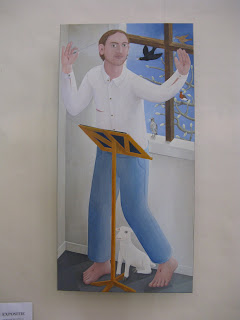
The Utrecht cathedral was large and impressive. It was filled with contemporary art commissions. I took a number of pictures of old and new art, but this painting was my favorite.

It is titled 'The Director.' I wish I could remember who the painter is and when it was painted. A bit of observation reveals that this director is, in fact, Christ. We recognize that it is Jesus by the wounds in his hands and feet, the lamb on the floor, and the crossbeams of the window. The director's gaze is emphatically aimed at us, who, in looking at the painting, become incorporated within the work of art as we find that we are the ones who are being directed. It is a simple, poignant, and direct image that carefully balances a profound truth about the universe with a rather mundane human scene.

After going to the cathedral, we visited the tower. I can't remember how many steps we climbed to get to the top, but it was a lot. The view was worth it.
Bit of trivia: the tower in Utrecht at one time housed the highest (in terms of elevation) bar in The Netherlands. One of the original tower guards, who lived in the tower, got a little lonely and decided to open a bar inside the tower. Today, sadly, the tower is a museum for tourists and there is no working bar.

Below is a picture from the tower looking at the cathedral. If you have seen a cathedral before you might notice something is missing. Look carefully...
Its the nave! The cathedral does not have a nave! What you can see is the transept and the portion of the cathedral that houses the altar. In the sixteenth century a nave was built for the cathedral to connect what you see in this picture to the tower. In its glory days, you would walk under the tower and into the cathedral, but now there is a square that separates the tower from the cathedral. What happened, you ask? Well, by the time they got around to building the nave, the protestant reformation had happened, and people weren't as keen on funding large church building projects. So they built the nave, but decided to leave out what seemed, at the time, to be a superfluous element: the flying buttresses! One fateful evening, a large storm blew through Utrecht and knocked down the nave. The rubble remained there for 150 years until it was finally removed and replaced with a very nice square.

After Utrecht, we went to Amsterdam. Below is a picture that I took of the Rijksmuseum from the large park in the museum quarter.
The Rijksmuseum houses a remarkable collection of 16th century Dutch paintings. This is the primary reason, even more than the conference, that I wanted to go to The Netherlands. All the big names were there: Rembrandt, Vermeer, Jan Steen, Frans Hals and more. They have an excellent collection of Dutch Genre Painting (my personal favorite). In short, this is like the mecca of my painting world (more than the Louvre, the Uffizi, the Tate, or the MOMA). The Rembrandts in particular were stunning. Just getting to see 'The Nightwatch' (which is gigantic) made it worth it.

After the Rijksmuseum, I went to the Van Gogh Museum. As art museums go, this was one of the best I had ever been to. I actually came away feeling as though I had learned a lot about Van Gogh and his paintings. See his work in person is a must. The prints don't cut. The man could lay paint on the canvas like nobody else (some of his paintings had to be close to an inch thick). His sense of color was absolutely mind boggling, especially to someone who has never been good at utilizing color in paintings. And Starry Night lives up to the hype.
Walking through the two museums was an absolute privilege. The experience of seeing these paintings in person will stay with me a long time: at least until I get back to Amsterdam.

I also went to the Anne Frank house. This was exceedingly powerful. It had been awhile since I had really thought about the Holocaust, and certainly a long time since I had been confronted with the many disturbing images and stories. I had forgotten the horror of it, and I was affected in new ways by this exhibit. It is hard to say much more, or really anything at all, after walking through the Anne Frank house.

And, of course, Amsterdam would not be complete without tulips and canals. So, I leave you with these two photographs.

Friday, February 13, 2009

What Is Creation Ex Nihilo?

How are we to understand what Creation ex nihilo is? The ‘ex nihilo’ part undoubtedly signals that whatever God was doing when he created the universe extends beyond human comprehension and experience. We do not know how to make something from nothing, and though we can find interesting analogies they fall short very quickly. Any yet the ‘creation’ part suggests that God was doing something not totally foreign to the world that he made. As Dorothy Sayers points out, “We use the word ‘create’ to convey an extension and amplification of something that we do know, and we limit the application of the metaphor precisely as we limit the application of the metaphor of fatherhood.” (21) If we are talking about two different activities we might use different words to describe them (such as sweeping the floor and mowing the lawn), but at the same time recognize that there is a same word (chore) which points to their similarities. Thus, it seems that Sayers is arguing that both human beings and God ‘create,’ but that ‘creation ex nihilo’ points out that they create in different ways.

It is of great importance, however, that we construct an analogy between creation ex nihilo and human creativity very carefully. If the gardener and the maid were to have lunch and discuss the similarties between their respective ‘chores,’ much common ground may be found, but at the same time their intimate knowledge of their respective occupations may lead them to discuss ‘the finer points’ of mowing the lawn or sweeping the floor. They each may find that the peculiarities of their task are essential to understanding what their task is, and so, for both of them, ‘chore’ cannot possibly come close to saying all that needs to be said. Analogies, then, are helpful because they can point out similarities between different things (‘sweeping the floor is like mowing the lawn), but at the same time analogies may conceal significant differences. In the case of human creativity and divine creation ex nihilo, ‘analogy’ may be too strong a word because the mystery of the creative act that brought into existence all time, space, and matter far outweighs anything that can be said positively about it. Therefore, one might say that human experience can provide some insights into creation ex nihilo, but little more than that. Let us consider two (potential) insights, one from Dorothy Sayers and the other from M. B. Foster, that attempt to shed some light on creation ex nihilo.

Dorothy Sayers, in her book the Mind of the Maker argues that humans have experience of something approximating creation ex nihilo. She writes that “It is the artist who, more than other men, is able to create something from nothing. A whole artistic work is immeasurably more than the sum of its parts.” (22) Most people would agree that this is a peculiar feature of a work of art as opposed to, say, a grocery cart. The grocery cart has little significance or meaning apart from its intended use, and so, unless it was imbued with some greater significance or value, we would hesitate to call it art. Sayers goes on to argue that we have “experience that the work of art has real existence apart from its translation into material form.” (22) Here it seems to me, she makes a mistake. Although it would seem that, if art is something greater than a physical object, one could have access to or experience of a work of art apart from the physical object, she has made a tacit assumption about the nature of the work of art: that the material and imaginary components of a work of art can somehow be separated. She argues that we experience creation ex nihilo in the world of the imagination, but not the material world. Her distinction between the imaginary work of art and the physical work of art is fully articulated in her description of the creative process where the Idea in the mind of the artist is the complete work of art prior to its translation into material form.

I would like to suggest that Sayers is both right (the work of art is more than the sum of its parts) and wrong (we do not have experience of the work of art apart from its translation into material form). M. B. Foster, in his article “The Doctrine of Creation and the Rise of Modern Natural Science,” will help me to articulate how this is so. To show what creation ex nihilo means, Foster begins by showing what it is not. Creation ex nihilo is not, as numerous theologians have argued, the Platonic Demiurge who creates like a Cosmic Craftsman. Plato argues that the Demiurge created the world by taking eternal matter and forming it according to an eternal pattern. Theologians have rightly seen that creation ex nihilo means there can be no eternal matter or pattern. And yet, as Foster shows, it means quite more than this.

The Demiurge, Foster argues, creates according to his intellect. Foster writes, “The the form of an object is intelligible, means that it is distinguishable in conception from the sensible material of its embodiment.” (462) For example, if God creates various things in the world according to a pattern or Idea in His mind, they may be said to have form distinguishable from their materiality. To the extent that God has an ‘end’ in mind prior to creating the world, we may say that his creativity is purposive and that the conception of the material object exists apart from the actual material object. The grocery cart was made according to a plan (the end, which is the ideal grocery cart), and so the conception of what a grocery cart is can exist entirely apart from the grocery cart.

Foster argues that the Christian God, who creates ex nihilo, creates according to his will. This implies that “there is no end distinctly conceived by the creator in advance of his execution, so there is no form distinguishable by us from the accidents of its embodiment.” (462) Only if there is a clear plan prior to the act of creation can the conception of the created thing be distinguishable from the material created thing. To show how this is so he employs an analogy between divine and human creativity:

It is notorious that the creative artist, e.g. the painter, has no clear knowledge of what he is going to achieve before he has achieved it; and the critic on his side, when confronted with a work of creative art, is indeed aware that there is ‘something more’ in it than the sensible material—a great painting is more than a certain complexity of coloured surfaces – but this ‘something more’ (we may loosely call it the ‘meaning’) is not capable of being conceived in distinction from the sensible material in which it is expressed. (462)

We may say then that the meaning of the painting is not intelligible in the same way that the meaning of the grocery cart is. Every feature of the grocery cart contributes to the ‘end,’ the plan, according to which it was designed. But in God’s creation there is an element of contingency, which “is sensible only, without being intelligible.”(463) There are things in creation which simply are, and there is no ‘reason’ for their being the way they are.

Sayers’ reliance on the Platonic Demiurge as a background for her thoughts about creativity is made even clearer in her understanding of what an artistic idea is. She argues that a book, for example, can be completed in the artist’s mind prior to being put down on paper. The imaginary book and the written book are only different to the extent that the written book gives the author a greater awareness and understanding of the imaginary book. Thus, the meaning in the written book can be reduced to the idea in the mind of the author. Once a person (author or reader) has understood the idea that formed the book, there appears to be little reason for reading the book because the idea and written book are essentially the same.

If creation ex nihilo means that there is no eternal material and that there is no eternal pattern, then it is quite easy to see how the meaning of creation “is not capable of being conceived in distinction from the sensible material in which it is expressed.” Foster argues that this forms the basis for modern empirical science because it requires people to go out and take a good hard look at creation to know what it is. But the same must be, at least to some extant, true of God as well. If God cannot simply deduce from the Ideas in his mind the 'meaning' of creation, but must actually look at it, then his point of view is not entirely different from ours. Thus, because of creation ex nihilo, I would like to suggest that God’s relationship to creation as Creator is best described as Kenotic.

But how does God relate to His creation as Creator now that the creation ex nihilo is finished. Is God creating anything else? We may point to God’s creative efforts to sustain creation and bring it to completion in the New Creation. These activities are indeed aimed at ‘making all things new,’ but are not the same as creation ex nihilo. Calling these activities Kenotic implies that analogies between human and divine creativity may, in fact, be more helpful than they originally appeared (for now that God has made something from nothing He must surely work with that ‘something’ to continue to be creative). Therefore, I would like to offer the following as starting points for an analogy between divine and human creativity: (1) God’s creativity works in and through the material universe, (2) God’s creative activities make space for the creative response of the ‘other,’ and (3) God’s creative activities collaborate with his creatures.

Wednesday, January 28, 2009

Wendell Berry on Art

My friend Tim Stone recommended that I read a chapter from Wendell Berry's Sex, Economy, Freedom, and Community titled "Christianity and the Survival of Creation." Berry presents a vision of the arts that departs quite nicely from the modern idea of creative genius. Here we find an ode to the craftsman. Berry moves technical skill to the center of the arts, and suggest that doing so may return the arts to their rightful place within human relatedness. I have transcribed a large chunk here for your enjoyment:

All of us are makers, within mortal terms and limits, of our lives, of one another's lives, of things we need and use.

This, Ananda Coomaraswamy wrote, is "the normal view," which "assumes... not that the artist is a special kind of man, but that every man who is not a mere idler of parasite is necessarily some special kind of artist." But since even mere idlers and parasites may be said to work inescapably, by proxy or influence, it might be better to say that everybody is an artist-- either good or bad, responsible or irresponsible. Any life, by working or not working, by working well or poorly, inescapably changes other lives and so changes the world. This is why our division of the "fine arts" from "craftsmanship," and "craftsmanship" from "labor," is so arbitrary, meaningless, and destructive. As Walter Shewring rightly said, both "the plowman and the potter have a cosmic function." And bad art in any trade dishonors and damages Creation.

Explaining "the perfection, order, and illumination" of the artistry of Shaker furniture makers, Coomaraswamy wrote, "All tradition has seen in the Master Craftsman of the Universe the exemplar of the human artist or 'maker by art,' and we are told to be 'perfect, even as your Father in heaven is perfect." Searching out this lesson, for us, of the Shakers' humble, impersonal, perfect artistry, which refused the modern divorce of utility and beauty, he wrote, "Unfortunately, we do not desire to be such as the Shaker was; we do not propose to 'work as though we had a thousand years to live, and as though we were to die tomorrow.' Just as we desire art but not the things that make for art ... we have the art that we deserve. If the sight of it puts us to shame, it is with ourselves that the reformation must begin."

Any genuine effort to "re-form" our arts, our ways of making, must take thought of "the things that make for art." We must see that no art begins in itself; it begins in other arts, in attitudes and ideas antecedent to any art, in nature, and in inspiration. If we look at the greatest artistic traditions, as it is necessary to do, we will see that they have never been divorced either from religion or from economy. The possibility of an entirely secular art and of works of art that are spiritless or ugly or useless is not a possibility that has been among us for very long. Traditionally, the arts have been ways of making that have placed a just value on their materials or subjects, on the uses and the users of the things made by art, and of the artists themselves. The have, that is, been ways of giving honor to the works of God. The great artistic traditions have had nothing to do with what we call "self-expression." They have not been destructive of privacy or exploitive of private life. Though they have certainly originated things and employed genius, they have no affinity with the modern cults of originality and genius. Coomaraswamy, a good guide as always, makes an indispensable distinction between genius in the moder sense and craftsmanship: "Genius inhabits a world of its own. The master craftsman lives in a world inhabited by other men: he has neighbors." The arts, traditionally, belong to the neighborhood. They are the means by which the neighborhood lives, works, remembers, worships, and enjoys itself.

But most important of all, now, is to see that the artistic traditions understood every art primarily as a skill or craft and ultimately as a service to fellow creatures and to God. An artist's first duty, according to this view, is technical. It is assumed that one will have talents, materials, subjects--perhaps even genius or inspiration or vision. But these are traditionally understood not as personal properties with which one may do as one chooses but as gifts of God or nature that must be honored in use. One does not dare to use these things without the skill to use them well. As Dante said of his own art, "far worse than in vain does he leave the shore ... who fishes for the truth and has not the art." To use gifts less than well is to dishonor them and their Giver. There is no material or subject in Creation that in using, we are excused from using well; there is no work in which we are excused from being able and responsible artists.

Wendell Berry, Sex, Economy, Freedom and Community, pp. 110 - 113.