How are we to understand what Creation ex nihilo is? The ‘ex nihilo’ part undoubtedly signals that whatever God was doing when he created the universe extends beyond human comprehension and experience. We do not know how to make something from nothing, and though we can find interesting analogies they fall short very quickly. Any yet the ‘creation’ part suggests that God was doing something not totally foreign to the world that he made. As Dorothy Sayers points out, “We use the word ‘create’ to convey an extension and amplification of something that we do know, and we limit the application of the metaphor precisely as we limit the application of the metaphor of fatherhood.” (21) If we are talking about two different activities we might use different words to describe them (such as sweeping the floor and mowing the lawn), but at the same time recognize that there is a same word (chore) which points to their similarities. Thus, it seems that Sayers is arguing that both human beings and God ‘create,’ but that ‘creation ex nihilo’ points out that they create in different ways.
It is of great importance, however, that we construct an analogy between creation ex nihilo and human creativity very carefully. If the gardener and the maid were to have lunch and discuss the similarties between their respective ‘chores,’ much common ground may be found, but at the same time their intimate knowledge of their respective occupations may lead them to discuss ‘the finer points’ of mowing the lawn or sweeping the floor. They each may find that the peculiarities of their task are essential to understanding what their task is, and so, for both of them, ‘chore’ cannot possibly come close to saying all that needs to be said. Analogies, then, are helpful because they can point out similarities between different things (‘sweeping the floor is like mowing the lawn), but at the same time analogies may conceal significant differences. In the case of human creativity and divine creation ex nihilo, ‘analogy’ may be too strong a word because the mystery of the creative act that brought into existence all time, space, and matter far outweighs anything that can be said positively about it. Therefore, one might say that human experience can provide some insights into creation ex nihilo, but little more than that. Let us consider two (potential) insights, one from Dorothy Sayers and the other from M. B. Foster, that attempt to shed some light on creation ex nihilo.
Dorothy Sayers, in her book the Mind of the Maker argues that humans have experience of something approximating creation ex nihilo. She writes that “It is the artist who, more than other men, is able to create something from nothing. A whole artistic work is immeasurably more than the sum of its parts.” (22) Most people would agree that this is a peculiar feature of a work of art as opposed to, say, a grocery cart. The grocery cart has little significance or meaning apart from its intended use, and so, unless it was imbued with some greater significance or value, we would hesitate to call it art. Sayers goes on to argue that we have “experience that the work of art has real existence apart from its translation into material form.” (22) Here it seems to me, she makes a mistake. Although it would seem that, if art is something greater than a physical object, one could have access to or experience of a work of art apart from the physical object, she has made a tacit assumption about the nature of the work of art: that the material and imaginary components of a work of art can somehow be separated. She argues that we experience creation ex nihilo in the world of the imagination, but not the material world. Her distinction between the imaginary work of art and the physical work of art is fully articulated in her description of the creative process where the Idea in the mind of the artist is the complete work of art prior to its translation into material form.
I would like to suggest that Sayers is both right (the work of art is more than the sum of its parts) and wrong (we do not have experience of the work of art apart from its translation into material form). M. B. Foster, in his article “The Doctrine of Creation and the Rise of Modern Natural Science,” will help me to articulate how this is so. To show what creation ex nihilo means, Foster begins by showing what it is not. Creation ex nihilo is not, as numerous theologians have argued, the Platonic Demiurge who creates like a Cosmic Craftsman. Plato argues that the Demiurge created the world by taking eternal matter and forming it according to an eternal pattern. Theologians have rightly seen that creation ex nihilo means there can be no eternal matter or pattern. And yet, as Foster shows, it means quite more than this.
The Demiurge, Foster argues, creates according to his intellect. Foster writes, “The the form of an object is intelligible, means that it is distinguishable in conception from the sensible material of its embodiment.” (462) For example, if God creates various things in the world according to a pattern or Idea in His mind, they may be said to have form distinguishable from their materiality. To the extent that God has an ‘end’ in mind prior to creating the world, we may say that his creativity is purposive and that the conception of the material object exists apart from the actual material object. The grocery cart was made according to a plan (the end, which is the ideal grocery cart), and so the conception of what a grocery cart is can exist entirely apart from the grocery cart.
Foster argues that the Christian God, who creates ex nihilo, creates according to his will. This implies that “there is no end distinctly conceived by the creator in advance of his execution, so there is no form distinguishable by us from the accidents of its embodiment.” (462) Only if there is a clear plan prior to the act of creation can the conception of the created thing be distinguishable from the material created thing. To show how this is so he employs an analogy between divine and human creativity:
It is notorious that the creative artist, e.g. the painter, has no clear knowledge of what he is going to achieve before he has achieved it; and the critic on his side, when confronted with a work of creative art, is indeed aware that there is ‘something more’ in it than the sensible material—a great painting is more than a certain complexity of coloured surfaces – but this ‘something more’ (we may loosely call it the ‘meaning’) is not capable of being conceived in distinction from the sensible material in which it is expressed. (462)
We may say then that the meaning of the painting is not intelligible in the same way that the meaning of the grocery cart is. Every feature of the grocery cart contributes to the ‘end,’ the plan, according to which it was designed. But in God’s creation there is an element of contingency, which “is sensible only, without being intelligible.”(463) There are things in creation which simply are, and there is no ‘reason’ for their being the way they are.
Sayers’ reliance on the Platonic Demiurge as a background for her thoughts about creativity is made even clearer in her understanding of what an artistic idea is. She argues that a book, for example, can be completed in the artist’s mind prior to being put down on paper. The imaginary book and the written book are only different to the extent that the written book gives the author a greater awareness and understanding of the imaginary book. Thus, the meaning in the written book can be reduced to the idea in the mind of the author. Once a person (author or reader) has understood the idea that formed the book, there appears to be little reason for reading the book because the idea and written book are essentially the same.
If creation ex nihilo means that there is no eternal material and that there is no eternal pattern, then it is quite easy to see how the meaning of creation “is not capable of being conceived in distinction from the sensible material in which it is expressed.” Foster argues that this forms the basis for modern empirical science because it requires people to go out and take a good hard look at creation to know what it is. But the same must be, at least to some extant, true of God as well. If God cannot simply deduce from the Ideas in his mind the 'meaning' of creation, but must actually look at it, then his point of view is not entirely different from ours. Thus, because of creation ex nihilo, I would like to suggest that God’s relationship to creation as Creator is best described as Kenotic.
But how does God relate to His creation as Creator now that the creation ex nihilo is finished. Is God creating anything else? We may point to God’s creative efforts to sustain creation and bring it to completion in the New Creation. These activities are indeed aimed at ‘making all things new,’ but are not the same as creation ex nihilo. Calling these activities Kenotic implies that analogies between human and divine creativity may, in fact, be more helpful than they originally appeared (for now that God has made something from nothing He must surely work with that ‘something’ to continue to be creative). Therefore, I would like to offer the following as starting points for an analogy between divine and human creativity: (1) God’s creativity works in and through the material universe, (2) God’s creative activities make space for the creative response of the ‘other,’ and (3) God’s creative activities collaborate with his creatures.
Friday, February 13, 2009
Wednesday, January 28, 2009
Wendell Berry on Art
My friend Tim Stone recommended that I read a chapter from Wendell Berry's Sex, Economy, Freedom, and Community titled "Christianity and the Survival of Creation." Berry presents a vision of the arts that departs quite nicely from the modern idea of creative genius. Here we find an ode to the craftsman. Berry moves technical skill to the center of the arts, and suggest that doing so may return the arts to their rightful place within human relatedness. I have transcribed a large chunk here for your enjoyment:
All of us are makers, within mortal terms and limits, of our lives, of one another's lives, of things we need and use.
This, Ananda Coomaraswamy wrote, is "the normal view," which "assumes... not that the artist is a special kind of man, but that every man who is not a mere idler of parasite is necessarily some special kind of artist." But since even mere idlers and parasites may be said to work inescapably, by proxy or influence, it might be better to say that everybody is an artist-- either good or bad, responsible or irresponsible. Any life, by working or not working, by working well or poorly, inescapably changes other lives and so changes the world. This is why our division of the "fine arts" from "craftsmanship," and "craftsmanship" from "labor," is so arbitrary, meaningless, and destructive. As Walter Shewring rightly said, both "the plowman and the potter have a cosmic function." And bad art in any trade dishonors and damages Creation.
Explaining "the perfection, order, and illumination" of the artistry of Shaker furniture makers, Coomaraswamy wrote, "All tradition has seen in the Master Craftsman of the Universe the exemplar of the human artist or 'maker by art,' and we are told to be 'perfect, even as your Father in heaven is perfect." Searching out this lesson, for us, of the Shakers' humble, impersonal, perfect artistry, which refused the modern divorce of utility and beauty, he wrote, "Unfortunately, we do not desire to be such as the Shaker was; we do not propose to 'work as though we had a thousand years to live, and as though we were to die tomorrow.' Just as we desire art but not the things that make for art ... we have the art that we deserve. If the sight of it puts us to shame, it is with ourselves that the reformation must begin."
Any genuine effort to "re-form" our arts, our ways of making, must take thought of "the things that make for art." We must see that no art begins in itself; it begins in other arts, in attitudes and ideas antecedent to any art, in nature, and in inspiration. If we look at the greatest artistic traditions, as it is necessary to do, we will see that they have never been divorced either from religion or from economy. The possibility of an entirely secular art and of works of art that are spiritless or ugly or useless is not a possibility that has been among us for very long. Traditionally, the arts have been ways of making that have placed a just value on their materials or subjects, on the uses and the users of the things made by art, and of the artists themselves. The have, that is, been ways of giving honor to the works of God. The great artistic traditions have had nothing to do with what we call "self-expression." They have not been destructive of privacy or exploitive of private life. Though they have certainly originated things and employed genius, they have no affinity with the modern cults of originality and genius. Coomaraswamy, a good guide as always, makes an indispensable distinction between genius in the moder sense and craftsmanship: "Genius inhabits a world of its own. The master craftsman lives in a world inhabited by other men: he has neighbors." The arts, traditionally, belong to the neighborhood. They are the means by which the neighborhood lives, works, remembers, worships, and enjoys itself.
But most important of all, now, is to see that the artistic traditions understood every art primarily as a skill or craft and ultimately as a service to fellow creatures and to God. An artist's first duty, according to this view, is technical. It is assumed that one will have talents, materials, subjects--perhaps even genius or inspiration or vision. But these are traditionally understood not as personal properties with which one may do as one chooses but as gifts of God or nature that must be honored in use. One does not dare to use these things without the skill to use them well. As Dante said of his own art, "far worse than in vain does he leave the shore ... who fishes for the truth and has not the art." To use gifts less than well is to dishonor them and their Giver. There is no material or subject in Creation that in using, we are excused from using well; there is no work in which we are excused from being able and responsible artists.
Wendell Berry, Sex, Economy, Freedom and Community, pp. 110 - 113.
Friday, January 16, 2009
Durham Conference: Jan. 13, 14 2009

Postgraduates at the University of Durham organized and hosted a conference on interdisciplinarity in theology and religion (Subtitle: How to Tie Knots that Will Hold). I was able to attend the two days of the conference (Jan, 13, 14) and had a wonderful time.
Sarah Coakley gave an excellent keynote address on her own experience as an interdisciplinary researcher. She has had a fascinating career as a researcher that has included projects with the Mind, Brain, Behavior group at Harvard as well as a recent collaborative project with the game theorist Micheal Nowak. Look out for an upcoming book co-written by Coakley and Nowak that has the potential to change the landscape of research in the area of science and religion. Also, she recently edited a book on pain that I am hoping to read at some point, and I recommend it to anyone else interested in the subject.
The conference was composed of primarily post graduate students (my guess is about 60). There was lots of time (although more would have been nice) to get to know one another and hear about each other's research interests. Because of the nature of the conference everyone was doing such different and unique things. There were projects ranging from the more traditional (such as The Role of the Holy Spirit in Deification in Athanasius) to the more popular interdisciplinary areas (such as my own project on the analogy between divine and human creativity, Church and Empire, music and theology) to the unique and unusual (such as Christian belief and the popular UK practice of woodland burial, how christians watch reality tv, and angelology as a necessarily interdisciplinary discipline). Everything was fascinating and there was a general sense of curiosity about one another's projects that pervaded the conference.
I also had the opportunity to present my own work in the form of a paper titled, "Is Creation the Expression of the Creator? An Exploration in Theology, Art, and Philosophy. " (click on title to read paper) This is the first time that I have presented a paper at a conference, and I was very happy with the way that it went. The discussion time afterward, which seemed to last a long time (there had to have been at least 15 questions/comments) went well and I received a good response and good constructive criticism. I really enjoyed the question time. It was fun to have people interact with my research and have the opportunity to respond and dialogue.
Two friends of mine from St Andrews also presented papers: Paul Warhust (on Kierkegaard as a Matthew scholar) and Christian George (on Pilgrimage as a locus of interdisciplinary study). I unfortunately did not attend Paul's, but I am sure it was excellent. I did attend Christian's, and I know his was excellent. He has got me thinking about how to appropriate prilgimage as a metaphor and christian practice today, as well as wishing that I had keynote on my pc so that I too can have graphics that make the other presenters salivate with longing.

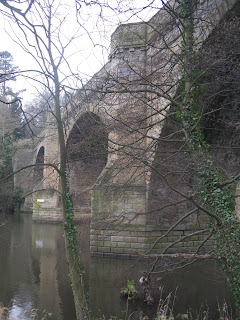
I also fell in love with Durham while we were there. Emily, Jonah, and I stayed in a great little bed and breakfast called the Chestnut Villa. The oldest portion of town is situated on a hill inside a bend in the beautiful river Wear. Durham Cathedral (more than 1000 years old) dominates the landscape, along with the castle that is connected to it. I could have spent two days inside the cathedral instead of the conference. The sense of scale produced by the walls that seem to shoot up and soar overhead is overwhelming. There were a number of stain glass windows of immense size and intricacy. And in one portion of the cathedral are a number of more contemporary art installations, including a massive pieta that is utterly captivating, evoking the deepest sorrow and tragedy alongside the glimmer of hope and resurrection.

Overall it was a great trip, even though a number of logistical things went wrong. Emily may comment on these in her blog post, but I won't go into them here. Here are a few more pictures that Emily won't show you:


Wednesday, January 7, 2009
Christ, Kenosis, and Creation
Colin Gunton argues, in his book Christ and Creation, that the relationship between Christ and Creation must be understood within the context of the Triune relationships. He writes, "It is because God the Father creates through the Son and Spirit, his two hands (Irenaeus), that we can conceive a world that is both real in itself, and yet only itself in relation to its creator.” The concept of Kenosis, the self-emptying of God, is typically empoyed to relate the Son of God, the second person of the Trinity, to Creation, and in what follows are some interesting comments on the relationship between Christ, Kenosis, and Creation:
“If the self-emptying is seen as the expression of the divine being rather than its depotentiation, it is a different matter altogether. The concept is used, for example, in Cyril of Alexandria. ‘The emptying was a voluntary reduction to our level, undertaken as an act of pure love … : “He who fills all things lowered Himself to emptying.” What is claimed is that the eternal relatedness of the Son to the world here takes, through the Spirit, a particular and unique form. Because the Father created and upholds the world in being through the Son, it is ontologically appropriate, so to speak, for the Son to be the one who takes on flesh. The one who holds in being the realms of time and space enters their confines in order to renew them. In that respect, the emptying is an expression at once of the love of the Son and of his being in relation with that which was created through and is upheld by him. Kenosis is therefore one concept by which we may express the way in which the eternal Son related himself to that which is not God—to the creation.”
Gunton goes on to say that “It is doubtful whether the continuity between creation and incarnation should be expressed by calling the activity of divine creation also an act of Kenosis. It is one thing to give to the world a being and form, another to enter its fallen structures to renew them.” I have two comments about this statement.
First, Gunton seems to imply earlier that creation and kenosis are closely linked when he writes “the emptying is an expression at once of the love of the son and of his being in relation with that which was created through and is upheld by him.” How does one separate the love of God and the creativity of God? W. H. Vanstone writes, “Christianity should have no hesitation in attributing to God that authenticity of love which it recognizes in Christ – in attributing to the Creator that authenticity of love which it recognizes in the Redeemer.” The argument here is that the self-emptying of Christ, as implied in the incarnation and crucifixion, is indicative of a love for creation that God has in general.
Second, although the incarnation suggests the consummation of God’s creation, it does not ultimately reach that fulfillment, which is God dwelling with his creature in the New Creation. If “God dwelling with His creation” has been the final goal all along, then all of God’s creative activities could be called Kenotic for they strive toward intimate relatedness with Creation. The concept of Kenosis can be employed to describe the free relatedness of God to creation, because it is not only the Son who wishes to dwell with His creatures.
Saturday, January 3, 2009
Kenosis and Freedom
This one goes out to Shawn Bawulski. We have had a number of conversations about the nature of human freedom, and, while I am still far from having answers to the many questions that have come up, I came across an article by Sarah Coakley entitled "Kenosis: Theological Meanings and Gender Connotations" in The Work of Love (ed. John Polkinghorne) that is very helpful.
I have been wrestling with the idea that God's Kenosis is essential to his relationship with creation. Indeed, the idea for my phd dissertation is predicated upon the assumption that the analogous relationships Creator-creation and artist-artwork are characterized by kenosis: a "self-emptying" or "self-giving" on the part of the Creator/artist that ensures the "otherness" of creation/artwork. The Work of Love is a collection of essays that explores the theme of "Creation as Kenosis" as a response to classical doctrines of creation that emphasis omnipotence, omniscience, and immutability. Thus, "Creation as Kenosis" implies an amount of "vulnerability," "risk," and "sacrifice" on the part of the Creator.
Coakley points out what I had suspected, but not yet articulated. She writes, "the striking commitment in this book to a libertarian view of freedom may be the linchpin holding several other systematic choices together." (204) Libertarian freedom is the kind that considers a human being to be "free from conditioning control by another." (205) The visual picture of Kenosis, with its connotations of "limitation" and "otherness," provided in The Work of Love is one of God stepping aside so that His creatures won't be dominated. Coakley describes the picture as "a (very big) divine figure backing out of the scene, or restraining his influence, in order that other (little) figures may exercise completely independent thinking and acting." (205)
This picture, she argues, is a male-gendered picture of freedom. She connects this kind of freedom to "the male child's repudiation of the power of the mother." (205) There is a sense in which this freedom by distancing is a peculiarly male fantasy. "The underlying symbolish -- this argument goes on -- is of a normative 'masculine' self who gains independence by setting himself apart from that which gave him life and indeed continues to sustain him." (205) This type of freedom ensures "otherness," which is arguably essential for the existence of a loving relationship, by creating distance between God and his creation.
Does Kenosis present us with an alternative to libertarian freedom, or do the two go hand in hand? The alternative, Coakley argues, is compatibilist, but at the same time free from the determinism that the contributors of The Work of Love believe to characterize classical approaches to divine interaction with the world. She observes, in fact that such an alternative is ironically present within The Work of Love.
The alternative picture of Creator-creature interaction "undoes this assumption about the supposedly strangling effect of a continuous dependence on the divine." (206) What is suggested by Coakley, and Ian Barbour in his essay "God's Power: A Process View," is an understanding of God's power "not as overpowering but as empowering." (15) Barbour draws on the work of Anna Case-Winter (God's Power: Traditional Understanding and Contemporary Challenges, 1990) who suggests that God's power may be better understood in terms of mothering. The child's response to the mother is not in competition with the desires of the mother that the child become a full person in his/her own right. In fact, the child's response completes the activities of the mother. This type of freedom ensures the "otherness" of creation through the continual and intimate sustaining of the creature by the Creator.
Coakley concludes her thoughts on Kenosis and freedom by writing: "If we think of divine kenosis as required for a God who must get out of the way in order that 'freedom' be enacted, then one sort of gendered picture is probably in play; whereas if we think of God as nurturing and sustaining us into freedom (of a different, compatibilist, sort), then it may be that another set of gender associations are present in the background. For the latter view, it is not God who is in need of restriction or 'emptying', but rather a false form of hubristic human power." (206)
It is interesting that Kenosis should generate two different accounts of freedom, one based upon distance, the other on intimacy. Similarly, theologians writing about kenosis will use the terms "self-giving" and "self-emptying," as I did at the beginning of this post, despite their different connotations of fullness and absence. That the kenosis of God, primarily a theological concept about the relationship between Creator and creature, should be articulated in such disparate terms seems, to me at least, to be a good thing because it suggests the struggle within a relationship of persons to define one's self while leaving room for the 'other.'
I am also happily surprised to see that "Kenotic Theology" (if I can use the term) does not require one to accept libertarian freedom, but that compatibilism is an option as well. How libertarian freedom is articulated within a kenotic understanding of the relationship between Creator and creature appears to be fairly straightforward. How compatibilism is articulated, however, within the same understanding will require more thinking and reading on my part, as well as more conversations with Shawn Bawulski.
Wednesday, December 31, 2008
The Paradoxical Dorothy Sayers
I was reading through an interesting chapter in Dorothy Sayers Mind of the Maker today entitled "The Love of the Creature." My sense that she contradicts herself in varied ways throughout her book only grew as I read, and by the end of the chapter had become a full and confusing paradox. And at what point does a paradox become nonsense? How does one assess the truth of a paradox?
She concludes this chapter with an interesting statement where she affirms that the human artist is to an extant analagous to the Creator who creates what is a part of Himself and yet what is also independent of him. The paradox, of course is, how can creation be a part of the Creator and at the same time be independent of Him? She writes,
All [of the artist's] efforts and desires reach out to that ideal creative archetype in whose unapproachable image he feels himself to be made, which can make a universe filled with free, conscious and co-operative wills; a part of his own personality and yet existing independently within the mind of the maker.
Perhaps she offers her own solution to this conundrum when she writes "within the mind of the maker." One might ask, then, what kind of independence this really is.
She provides the reader with an afterthought, following her chapter "The Love of the Creature." It has little to do with what I have just commented on, but I thought it was funny and uncharacteristicly biting in comparison to the rest of her book. Discussing the relationship between fantasy in childhood and creativity she writes,
Evidence of a habit of fantasy in a child is no proof of creative impulse: on the contrary. The child who relates his fantasied adventures as though they were fact is about as far removed from creativeness as he can possibly be; these dreamy little liars grow up (if into nothing worse) into the feeble little half-baked poets who are the irritation and despair of true makers.
Maybe she was just having a bad day.
Monday, December 29, 2008
Love and the Problem of Disproportion
W. H. Vanstone, in his book Love's Endeavor, Love's Expense, reflects, "I knew of the God without Whom no sparrow falls to the ground. I could conceive, as a logical or theological possibility, that my tree, like the sparrow, might be important to God. But always the problem arose of disproportion or incongruity. [...] It was one thing to believe that God created all things, but another to believe that this 'fag-end' of His creation could be important to Him."
He then recounts a story about two boys who were looking for something to do on their holiday break from school. The boys came to Vanstone, searching for ideas, and he suggested that they build a model of a certain piece of land using sticks, rocks, paint and whatever other materials the could find. Despite the boys initial lack of enthusiasm, they chose to take on the project, and Vanstone reflects on their progress in an illuminating way.
Although the project began without much excitement, it quickly became an obsession: they would work long hours and miss meal times. He notes how "the placing each stone and twig was a matter for careful discussion." Once something was placed on the model, a moment of waiting and seeing if it was 'right' followed. New possibilities would arise after the placement of each piece, as well as new difficulties.
Vanstone writes that "As the model grew and became of greater value, each step in its creation became of greater moment and was taken with greater intensity of care. Each item that was placed seemed to possess greater power to make or to mar. [...] The once contemptible sticks and stones now had a certain power over those who were using them -- a power to effect or negate the completion of that which was being made, and so to satisfy or frustrate those who were making it. The two boys became vulnerable in and through that which, out of virtually nothing, they had brought into being."
"As I watched this microcosm of creative activity, and as later I reflected upon it, three things gradually became evident to me. The first was that, in such activity, there was both working and waiting. One could say that the activity of creating included the passivity of waiting -- of waiting upon one's workmanship to see what emerged from it, and to see if that which emerged was 'right.' The second, which followed from the first, was that, in such activity, the creator gave to, or built into, his workmanship a certain power over himself. He gave to his workmanship that which, if it were not his workmanship, it would not possess -- a power to affect himself, to have value, significance, or importance for himself. The third, which followed from the second, was that in such activity disproportion between creator and workmanship, or between creator and material, was overcome by the gift of value. That which in itself was nothing was transformed, in the creative process, into a thing of value: as the work of a creator, it received a new status in relation to the creator. The incongruity between the great and small was overcome when the creativity of the great was expended in and upon the small."
"Therefore, through this simple incident, I was helped to see that awareness of the importance of any aspect of material reality may be awareness not of its relevance to human well-being but simply of its being the work of love: and that a sense of responsibility for it may be a sense of responsibility for a work of love."
See W. H. Vanstone, Love's Endeavor, Love's Expense, 30 - 34.
On Theological Method
I came across a couple of paragraphs in the forward of Love's Endeavor (by W. H. Vanstone)that seem to encapsulate Vanstone's theological method. I am wrestling with many of these ideas at the moment because they seem to fit, and yet do not fit, within the evangelical tradition of my upbringing. Without saying any more, I turn to H. A. Williams:
Theological truth is the truth of God's relationship with man and it is the fruit not of learning but of experience. In this sense all theology, properly so called, is written in blood. It is an attempt to communicate what has been discovered at great cost in the deepest places of the heart -- by sorrow and joy, frustration and fulfillment, defeat and victory, agony and ecstasy, tragedy and triumph. Theology, properly so called, is the record of a man's wrestling with God. Wounded in some way or other by the struggle the man will certainly be, but in the end he will obtain the blessing promised to those who endure.
The theologian in this respect is no different from the poet or the dramatist. All of them must write in blood. Yet what the theologian is called to do with his experience is different from what the poet or dramatist does. [...] Its center of interest is different in two ways. First, the theologian's primary concern must always be God's relationship with man, and any relationship a man may have with his fellow-men or the world he lives in must always be subsumed under the primary relationship with God. Secondly, the theologian has been nurtured by a tradition of belief and practice and all the time he must relate his insights to the tradition which has nurtured him. However first hand, and in that sense original, those insights may be, they cannot be entirely out of the blue. They have to connect in some way with insights already achieved.
Monday, December 22, 2008
Can God's Creative Work Mean More Than He Meant?
George MacDonald writes, “One difference between God’s work and man’s is, that while God’s work cannot mean more than he meant, man’s must mean more than he meant … A man may well himself discover truth in what he wrote; for he was dealing all the time with things that came from thoughts beyond his own.” (Macdonald, A Dish of Orts, 320 – 321)
What does it mean for a work of art to go beyond the author’s intentions? Is a work of art simply the product or embodiment of the artists thoughts, feelings, mental states unless otherwise inspired? Is the reason that artists are often curious or puzzled about their own creations that they have been inspired by something beyond them? Do we have here a case where the inexplicable is simply filled in by the divine?
To say that “God’s work cannot mean more than he meant” is deceptively simple. We feel, at a gut and intuitive level, that this is a fitting description of God’s creative powers. Surely if anyone can express himself perfectly it is God, right? And yet, if we dig too deeply, we find problems. If what God “meant” before creating is the same as what creation means, how can time and space have any relevance to the meaning of creation? Everything in the created world is essentially reducible to what God “meant.” In this view, the particularity of each created thing, as well as the history of creation, appears irrelevant to the meaning of creation. God’s activities in creation could be construed, therefore, as God’s continuing attempt to ensure that creation means what he initially meant. This suggests a relationship between God and his creation that is unilateral: God responds primarily to his initial desires for creation without taking into consideration changing situations within his creation.
To say instead that God’s work does mean more than he meant, opens up different possibilities. The most obvious way in which creation can mean more than God initially meant is that creation is capable of generating its own meaningfulness. The free response of human beings to God and his creation participates in God’s creative activity either advancing or obstructing God’s redemptive movement in history. This is not to say that humans bring about God’s redemption and the New Creation (which is the meaning toward which God’s creative activities are striving), but that humans participate in God’s redemption by moving along side Him. God welcomes human beings, as representatives of his grace within creation, based on trust rather than control. God’s creative activities are inherently risky because He chooses to create something ‘other’ than himself, and to be in collaboration with that ‘other’ to determine the final outcome of His creativity.
Describing God’s creativity as being in collaboration presents all sorts of theological problems. Is God’s sovereignty somehow limited over creation? Can God become the victim of His creation? How does one articulate the freedom of human beings? Does God learn about His creation as its meaning unfolds to Him? Can God be surprised? While these problems and questions are serious, it seems to me that they are the inevitable problems of defining a loving relationship between God and His creation. That God loves his creation is impossible to refute from a Christian perspective. And so the question becomes, what does it mean to love someone else? Surely part of loving someone else is recognizing that the beloved, as well as the lover, brings something genuine and original to the relationship. It is from the perspective of the love of God that questions about God’s creativity must be explored.
Sunday, November 9, 2008
Some Thoughts on Looking at Things
I'm reading through Robert Farrar Capon's book The Supper of the Lamb. It is quickly becoming one of those books that I should have read a long time ago. The second chapter is an exercise, one I actually participated in at Regent College, in looking at an onion. Yes, it sounds less than exciting, but sitting with an onion the way that Capon does reminds me of the remarkable joy there is to find in things. His words at the end of this chapter resonate quite well, I think, with my own ruminations on looking and painting. So I thought I should record them for you here:
"Man's real work is to look at the things of the world and to love them for what they are. That is, after all, what God does, and man was not made in God's image for nothing. The fruits of his attention can be seen in all the arts, crafts, and sciences. It can cost him time and effort, but it pays handsomely. If an hour can be spent on one onion, think how much regarding it took on the part of that old Russian who looked at onions and church spires long enough to come us with St Basil's Cathedral."
"But if man's attention is repaid so handsomely, his inattention costs him dearly. Every time he diagrams something instead of looking at it, every time he regards not what a thing is but what it can be made to mean to him -- every time he substitutes a conceit for a fact -- he gets grease all over the kitchen of the world. Reality slips away from him; and he is left with nothing but the oldest monstrosity in the world: an idol. Things must be met for themselves. To take them only for their meaning is to convert them into gods -- to make them too important, and therefore to make them unimportant altogether. Idolatry has two faults. It is not only a slur on the true God; it is also an insult to true things."
"There is a Russian story about an old woman whose vices were so numerous that no one could name even one of her virtues. She was slothful, spiteful, envious, deceitful, greedy, foul-mouthed, and proud. She lived by herself and in herself; she loved no one and no thing. One day a beggar came to her door. She upbraided him, abused him, and sent him away. As he left, however, she unaccountably threw an onion after him. He picked it up and ran away. In time the woman died and was dragged down to her due reward in hell. But just as she was about to slip over the edge of the bottomless pit, she looked up. Above her, descending from the infinite distances of heaven, was a great archangel, and in his hand was an onion. 'Grasp this,' he said. 'If you hold it, it will lift you up to heaven.'"
"One real thing is closer to God than all the diagrams in the world."
There is something mildly idolatrous about posting this fantastic theological reflection that only comes after a 'meeting with the onion.' To ease my slightly guilty conscience, I now implore the reader to find Capon's Supper of the Lamb, and to make a date with an onion.

Subscribe to:
Posts (Atom)